
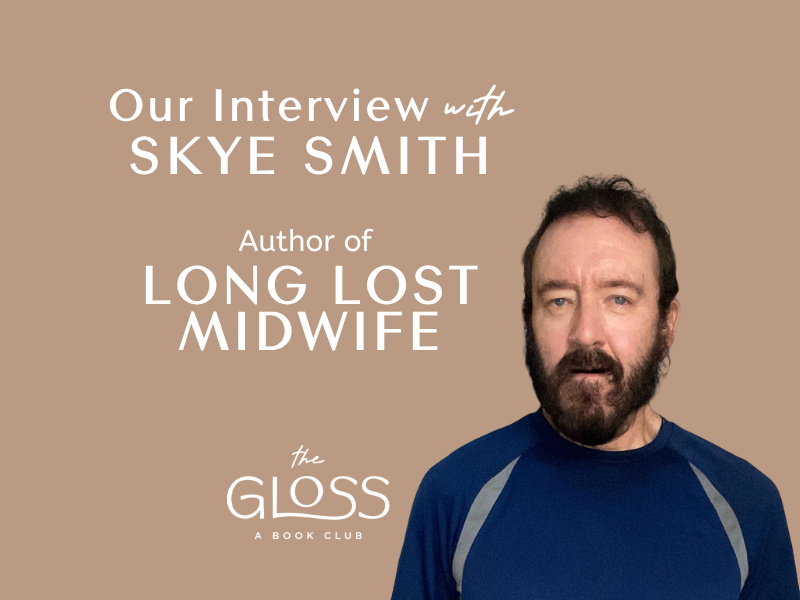

TGBC: What drew you to 1930s St. Louis as the setting? Was there something specific about that time and place that felt essential to Pamela’s story?
Skye Smith: Pamela was a character in another novel of mine. I didn’t know much about her, so early in 2020 I began backstory writing exercises to discover her more. I knew Pamela was from St. Louis, that she was wealthy and had Black house servants. At the time, my concept of ‘Black house servants’ was rather superficial. I live in Minneapolis. The George Floyd killing occurred in May 2020. Suddenly I found myself writing a novel with racism as a major theme.
TGBC: Miss Minnie is a central presence even before she appears on the page. How did you develop her character, and how did you approach writing across the racial divide of that era?
SS: LLM is dedicated to the real Miss Minnie I knew. I say ‘knew’ because she passed years ago. A friend of her son, Ernie, told me she was a cook for Ellis Arnall, Georgia governor 1943-1947. She was Black, a phenomenal cook, a bit crotchety, but always very kind to me.
In St. Paul, across the Mississippi from Minneapolis, exists the Penumbra Theater. It has performed many August Wilson plays. My Miss Minnie borrows a little bit from Ma Rainey in Wilson’s Ma Rainey’s Black Bottom.
The ‘racial divide’ of that era I can’t briefly summarize. ‘That era’ included the first years of The Great Depression. Also, the Supreme Court decision of Plessy vs. Ferguson of 1896 had, sadly, already been in effect for many years, and would be for many more. I constantly had to remind myself Martin Luther King, Jr. was only five years old at the time.
TGBC: You have a background in engineering, not writing. How did that career shape the way you construct a novel?
SS: I think it’s important to mention I moderated a MeetUp writer’s group for ten years. We had lawyers, doctors, MFAs in creative writing and others pass through that group. A great learning opportunity for which I’ll always be grateful.
Re: mechanical engineering: it’s quite unforgiving. Things must fit together and function correctly over time. If not, rework is expensive. My company specialized in industrial water purification. Their machine designs involved intricate plumbing and huge piping diameters. The CAD (computer aided design) software I used caught some interferences but not all. Rework shrank profit margins. I think of a novel’s plot lines like industrial plumbing: not only must everything work, it must continue to work
TGBC: The thriller elements don’t fully ignite until the second half. Was that pacing deliberate, and how do you think about building tension?
SS: The Independent Book Review’s Addison Ciuchta wrote: ‘The tension might be roasting slowly in the first half, but once it hits, it hits hard and fast.’ In response, I can only surmise that ‘roasting slowly’ refers to world- and character building. That takes time but, in my opinion, delivers the goods.
How do I think about building tension? In the mystery thriller genre, I know readers expect me to take them down a path toward ever-growing anxiety. That’s often done by piling calamity upon calamity. But I want my stories to be grounded in emotional depth. That means taking time to weave in nuance and subtlety.
TGBC: Pamela is a woman who keeps defying the people around her, often without fully understanding why herself. Did you know from the start what was driving her, or did you discover that as you wrote?
SS: Great question. Pamela’s somebody I had to discover. We had a contentious relationship. I tried my best to let her take control. I still don’t know what to think of her.
TGBC: What do you hope readers take away from her story?
SS: The Pamela in the book may not be the Pamela who emerges after the final page. It’s that Pamela I want readers to dwell on most.
TGBC: The book deals with race, gender, and autonomy in ways that feel very current even though they’re set in the 1930s. How intentional was that parallel?
SS: Education and employment opportunities for Blacks and women have fortunately improved since the early 1930s. But I was appalled to discover that employment for Black women in much of America at that time was strictly as a domestic. In Pinterest and in similar photo sites, I gazed for hours at photos of Black women dressed as servants holding white babies. Those photos haunt me still.
On the other hand, there are aspects of human behavior that-nearly a hundred years later- don’t change. Human evolution, I believe, doesn’t move as fast as technology. I simply followed this assumption.
TGBC: Maternal bonds are at the heart of this book. What research or personal experience informed how you wrote about that connection?
SS: Maternal bonds are most definitely at the heart of this book. Going back to Pinterest and the photos of Black women holding white babies: from a human perspective, I asked myself, what psychological dynamic was going on? I still don’t know the answer. But it occurred to me that it was possible a lot of white children of that era might have transferred their idea of ‘mother’ from their biological mother to whomever was holding them, regardless of skin color, encouraging them to walk and play, changing their diapers, and so forth.
These thoughts permeated my mind as Pamela and Miss Minnie took shape on the page.
TGBC: Books about women reclaiming their own stories tend to resonate deeply in reading groups. What conversations do you hope readers have after they finish?
SS: Oh, wow. That’s a tough one. Tough because many today describe our country as divided. So, the kinds of comments that might pop up after reading Long Lost Midwife could be all over the place. Things happen in this book that have the potential to offend some people. A discussion of race between races often tends to overheat.
All I can say: I’m a storyteller. In this instance, I’m telling other people’s stories. But I stand by my right to tell them. Even when I delve into what some may label as controversial subject matter. Flipping that around, for women reading this book: if things come up that provoke you to speak, don’t censure yourself. Speak your truth.