
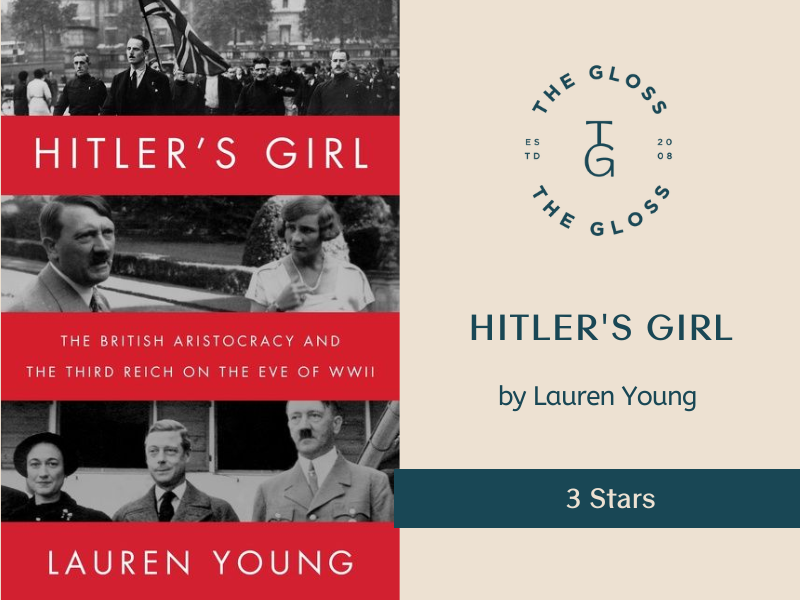
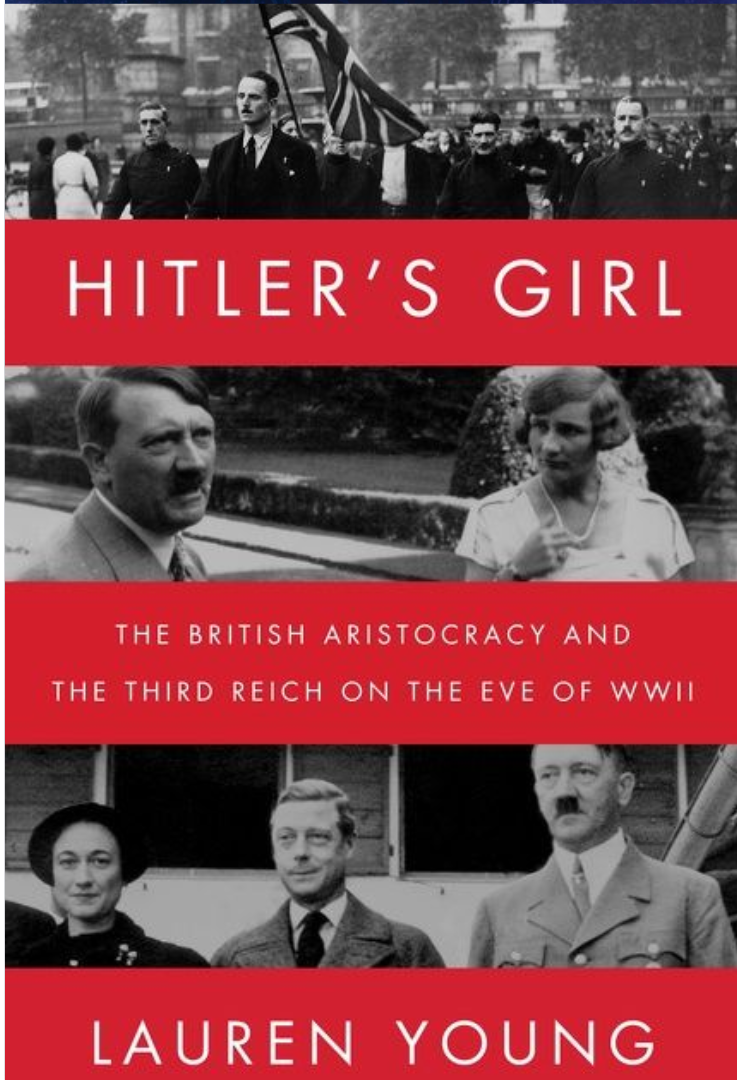
Hitler’s Girl by Lauren Young (Review by Lara Ferguson)
3/5
Lauren Young has done her research. Taking advantage of recently declassified documents, she has built an instructive and fascinating narrative that is disturbing to contemplate and from which it is difficult to look away.
Focused on the pro-German sentiment among the aristocracy in Great Britain during the years leading up to WWII and after, the book follows a young woman, Unity Mitford as she becomes obsessed with Adolf Hitler and schemes to put herself in his sights. Emboldened by anti-Semitism and pro-Fascist sentiment in Great Britain in the 1930’s, and aided by her family’s position amongst the aristocracy, Unity is able to scheme her way to Germany and the direct sight of Hitler, where she becomes an intimate part of his inner circle, his devoted supporter to the end, and perhaps beyond.
Within the story of Hitler’s Girl, Young exposes the devotion with which portions of Great Britain’s elite pursued a pro-German agenda sometimes working complicitly with the German government to further their goals. The book calls out individuals at the highest levels of the British government, using governmental documents to drive the point home, and illustrating the tenuous precipice that democracy balanced on at this point in time.
Drawing parallels to today’s political climate, Young exposes some of the weaknesses democracy faced just prior to WWII, the complacency and isolation, and asks the question—do we have to face a similar world event to fight for our democratic values, or will we learn from the past and fight against extremism before it destroys us.
GBC Reader Reviews

5 Comments
I found the book to be interesting. I had no idea how pro-Nazi the British aristocracy had been pre-WWII. However, I felt the material could have been better organized.The chapters moved one year to the next and back again I became somewhat lost with all the data particularly in the first 2 chapters. It would have been helpful to have a timeline of the key events.
If she had a bullet in her head, a simple X-Ray could prove it or disprove it!
She’s done her research?! I’m sorry but you are very mistaken. The book is full of errors! I’ll give you two: the Bazi newspaper was der Stürmer and on p.29, the author calls Chips Channon, Chips Cannon TWICE. Oh, and one more good one: Rudolf Hesse did not fly to Britain in 1941 in the hopes of avoiding a war between Britain and Germany. They had been at war for two while years by that point.
No book is without errors. Your comment is not free of errors either. There were several leading Nazi newspapers, not only one.
It was not Rudolf Hesse that flew to Britain but Rudolf Hess (or Heß). Hesse was a German/Swiss poet (1877 – 1962).
You are right, the war between UK and Germany had begun when Britain declared war on Germany in September 1939. But in 1941 the mass bombardments had not yet started,
This book may contain a few minor errors but has many more revealing merits. Naturally it is as unwelcome as is Antony C. Sutton’s book “Wall Street and the Rise of Hitler”.
It was not only the British aristocracy that was fascinated by Hitler but also a large part of the ruling political class.
It took 90 years and a brave US historian to demonstrate how fascinated many of the British decision makers were by Hitler, Mussolini’s and Stalin’s disciple. This book should have been written 80 years ago when the war was over and the culprits were still alive. Thanks to Lauren Young our eyes have now been opened.