
Interview with ReShonda Tate
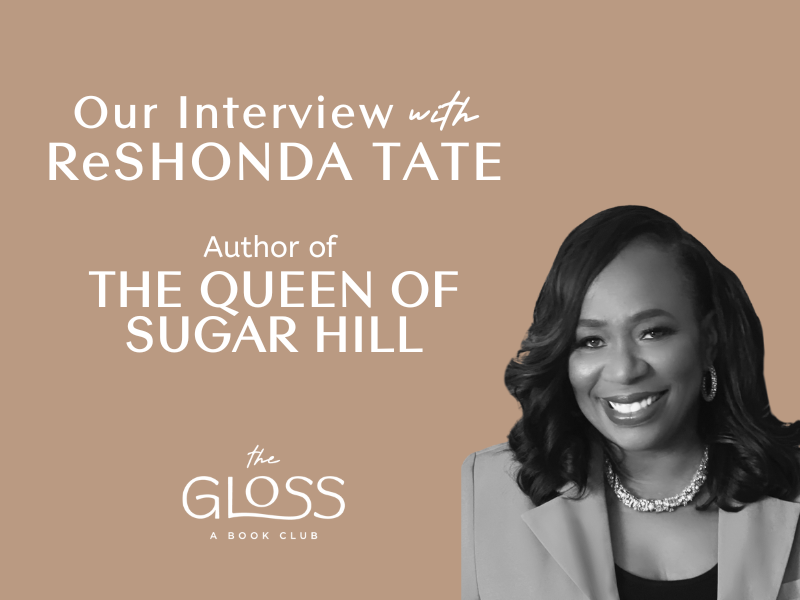

As a national bestselling author and award-winning journalist, ReShonda Tate has the credentials, and the passion, to bring stories to life. A highly sought-after motivational speaker/poet, ReShonda is a three-time nominee and previous winner of the NAACP Image Award for Outstanding Literature. She has received a plethora of distinguished awards and honors for her journalism, fiction, and poetry writing skills, including an induction into the Arkansas Black Hall of Fame and the Texas Literary Hall of Fame. Two of her novels have been made into television movies. Visit her website at www.reshondatate.com..
The Gloss Book Club: Can you provide a brief introduction to yourself and your journey as an author?
ReShonda Tate: I have loved making up stories ever since I was a little girl. My mother called it lying. But I had a passion for storytelling. I had my first published piece in a magazine called True Confessions. It was supposed to be a true story, but my story “I stole my sister’s husband” was completely made up, especially since I was only 15 and my sister was 12. But seeing my words on the page ignited a fire inside me. I got sidetracked after college when I began my career as a television news journalist. In 1999, I decided to return to my love of making up stories and wrote my first book. I self-published it after not being able to get a book deal. The book came out and did so well it caught the attention of an agent who got me a book deal with a major publisher. And the rest was history.
TGBC: What can you tell our members about your novel The Queen of Sugar Hill?
RT: The Queen of Sugar Hill is a fictional portrait of Hattie McDaniel, one of Hollywood’s most prolific but woefully underappreciated stars—and the first Black person ever to win an Oscar for her role as Mammy in the critically acclaimed film classic Gone With the Wind. It starts on the night in 1940, when Hattie won the historic award. The win was going to be life-changing. Or so she thought. The book tells the story of how after that night, not only did the Oscar curse set in where Hattie couldn’t find work, but she found herself thrust in the middle of two worlds—Black and White—and not being welcomed in either. Whites only saw her as Mammy and Blacks detested the demeaning portrayal. As the NAACP waged an all-out war against Hattie and actors like her, the emotionally conflicted actor found herself struggling daily. Through it all, Hattie continued her fight to pave a path for other Negro actors, while focusing on war efforts, fighting housing discrimination, and navigating four failed marriages. Luckily, she had a core group of friends to help her out—from Clark Gable to Louise Beavers to Ruby Berkley Goodwin and Dorothy Dandridge. It’s a story of resilience, dedication, and determination—about what it takes to achieve your dreams—even when everything—and everyone—is against you.
TGBC: Where did the inspiration for The Queen of Sugar Hill come from?
RT: Like so many, the first time I saw Mammy in “Gone With The Wind,” I was disgusted. I hated her character. I was watching with my grandmother and she asked me why I had so much disdain. I told her because Hattie McDaniel was playing a maid. My grandmother’s reply was, “I’m a maid and I give you a good life by being a maid. Hattie McDaniel is an actor playing the only roles she’s allowed to play. Plus, an actor isn’t the sum of their work.” Her words resonated with me. I began researching more about Hattie. And I realized Black people are the only people who aren’t allowed to “be” without it being a reflection of the entire race. There are white slapstick comedians, there are white actors who play unsavory roles, and they’re not judged by the totality of the whole race. In fact, that was one of Hattie’s arguments – why couldn’t she be allowed to simply be a comedian without being vilified as “shucking and jiving.” When I took off my 21st-century lens and looked at Hattie McDaniel in the time in which she lived, I was able to get a better understanding. And that’s what fascinated me about her. Then as I researched her, I was also fascinated by all I didn’t know. I didn’t know about the restrictive covenants. I didn’t know that she was the first Black woman to sing on the radio. I didn’t know about her wartime efforts, and I didn’t know about her struggle to find a seat at the table – both the Black table and the white table. And now that I do know, I hope to help others discover more about this fabulous woman.
TGBC: The book is based on the real life of Hattie McDaniel, how did you do your research to ensure historical accuracy?
RT: While the Internet was an invaluable tool in my research, I found that so much of Hattie McDaniel’s story had been distorted over the years. So I traveled across the country, visiting research libraries, her Sugar Hill home and the surrounding neighborhood. I did extensive research on Hattie’s life – from her humble beginnings to her successful blues career to her relocation to Los Angeles. I spent two years digging through her personal and professional story, continuously pulling back layers to things I didn’t know. I discovered her role in integration, how she fought to open doors for young Black actors, and her friendship with actors I loved from the Golden Age of Hollywood, like Clark Gable, Bette Davis, Dorothy Dandridge and Lena Horne. I visited research libraries, poured over Census records and devoured Black newspapers that covered her life. It was a journey of discovery and I loved every minute of it.
TGBC: On that point, when writing about a historical figure how important is it to you to be accurate, and how do you fill in the blanks that are unknown?
RT: As a journalist, I’m trained to unearth the facts, so that’s what I did. I wanted the foundation to be historically accurate. The fiction came in the things we don’t know that fill in the blanks. For example, we know Hattie and her Gone With the Wind co-stars went to a club after the Academy Awards and she was denied entry. The fiction comes in showing the reader her feelings, the nuances of that evening. I love sticking to the facts, then allowing my imagination to fill in the blanks.
TGBC: You’ve written over 53 novels – that’s incredible. How has your process changed from book one to book 53?
RT: This book is the most challenging that I’ve ever written. I usually research just to make sure I have situations, careers, etc, correct. This time, even though the book is fiction, I wanted to stay rooted in facts. So I had to do a lot of research to make sure the foundation was there, but oftentimes I would get lost in the research and spend way too much time on that. So that process was definitely different.
TGBC: I saw you read The Housemaid by Freida McFadden – we read that book as a club in January, is that your genre of preference or what books do you read for pleasure?
RT: I love suspense and thriller and recently discovered Freida McFadden, so I’m devouring her books and books like them because I love stories that keep me guessing. I’m reading The Housemaid’s Secret next. But I really do read all genres. I love historical fiction as well.
TGBC: How did your experience as a TV news anchor and reporter shape you as an author?
RT: I had to learn there is a big difference between writing for TV and writing novels. My first book was 63 pages because I had been trained to write tight. So I had to retrain my brain. I also know a lot about marketing and publicity because I’ve spent more than 25 years in the news business, so that’s helped me when it comes to marketing my book.
TGBC: Your books often fall within the contemporary fiction and romance genres. What draws you to these genres, and how do you keep them fresh and engaging for readers?
RT: I write books I would want to read. And as someone who has a short attention span, I have to deliver books that would keep me engaged. I respect my readers’ time, so I make sure that I deliver the best product possible.
TGBC: What advice do you have for aspiring authors, especially those from underrepresented backgrounds?
RT: Good books aren’t written, they’re rewritten. A lot of aspiring authors get off track because they sit down and try to write books like the books on their shelves. And then when they can’t, they get discouraged. If you saw the first draft of my books, you’d think I had some blackmail photos of my publisher. That’s because my first draft is usually awful because I’m simply getting the story out, then I go in and work my magic. So that’s one thing I would say. The other is you have to understand that writing the book is only half the journey. Writers, especially writers from underrepresented backgrounds, can’t take the “If you write it they will come” approach. You have to market your book (and not just wait on a publisher to market for you). Those are just some of my tips.